stockmarketCollection
Cbse On Screen Marking System Global Practices
Indian Express•
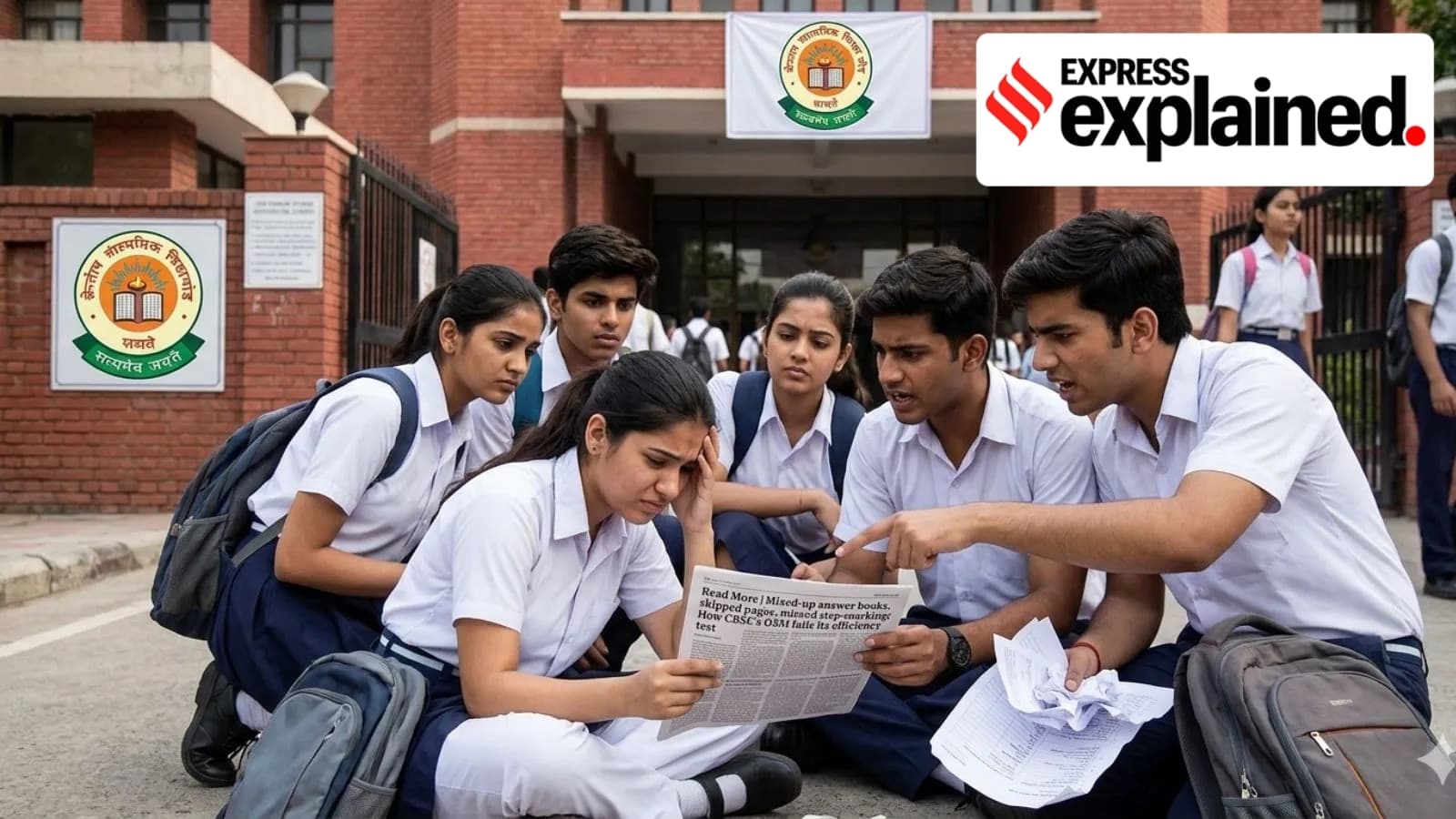
The Central Board of Secondary Education s (CBSE) decision to shift Class 12 evaluation to a fully digital On-Screen Marking (OSM) system this year has sparked debate after students reported blurred answer-book scans, missing pages and, in some cases, being sh... The Central Board of Secondary Education’s (CBSE) decision to shift Class 12 evaluation to a fully digital On-Screen Marking (OSM) system this year has sparked debate after students reported blurred answer-book scans, missing pages and, in some cases, being shown another candidate’s answer script. While the controversy has focused attention on the rollout, the idea behind digital evaluation is not new. Examination boards in countries such as the United Kingdom have used various forms of online marking for years. At the same time, education experts warn that technology can support assessment, but cannot replace the professional judgement of teachers. On-Screen Marking, or OSM, is a digital evaluation system in which teachers assess scanned copies of answer books on a computer rather than checking physical scripts. Students still write their examinations in conventional answer booklets. The change begins after the exam, when answer books are scanned, uploaded onto a secure platform, anonymised and distributed digitally to evaluators. CBSE says the idea is not new. The Board first explored OSM in 2014 but did not proceed because suitable scanning technology was not available. At the time, answer books often had to be cut from the spine before scanning, creating the risk of pages being mixed up. According to CBSE, the objective was to make evaluation more uniform, efficient and secure. The Board believed digital evaluation would reduce regional variations in marking, eliminate clerical mistakes in totalling marks, improve monitoring of evaluators and strengthen the overall examination process. Before implementation, CBSE conducted a dry run involving teachers from Kendriya Vidyalayas, Navodaya Vidyalayas, state government schools and private schools. Dr. Latika Gupta, Assistant Professor of Education, argues that the very premise of OSM is flawed. “Its whole goal is speedy checking. If you scan and make answer books available on a computer, it will lead to speedy checking and therefore results can be declared sooner. But that itself is a faulty understanding of evaluation,” she said. According to Gupta, evaluation is not merely about checking answer scripts and declaring results. “Teachers meet at centres, discuss, arrive at a collective understanding. There are subject heads who also evaluate copies and discuss them. Teachers grow in the process,” she said. What do researchers say about digital evaluation? Research from countries that have used online marking for years generally points to improved consistency. A study commissioned by Britain’s examinations regulator found that “markers using online marking systems showed greater consistency in the application of mark schemes than those using traditional paper-based methods.” Assessment researcher Victoria Crisp has argued that digital systems offer better opportunities for standardisation and quality monitoring. At the same time, experts caution that technology does not eliminate mistakes altogether. Researchers from Cambridge Assessment have noted that digital marking changes the nature of errors
ios_share
Share this article
Article Details
Indian Expressstockmarket