nationalOtt
Why Brazil Keep Turning To Neymar
Hindustan Times•
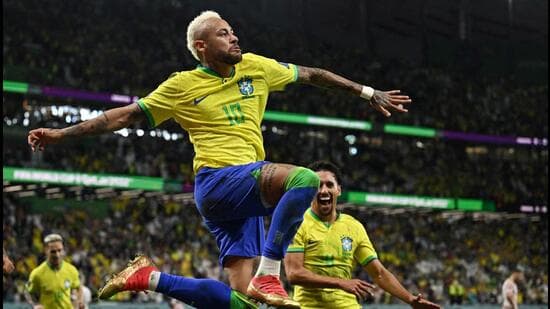
Kolkata: For all the tactical sophistication that makes Carlo Ancelotti perhaps the most universally respected coach of his era, there is something undeniably perplexing about the Italian trying to build any part of Brazil s World Cup project around Neymar. It... Kolkata: For all the tactical sophistication that makes Carlo Ancelotti perhaps the most universally respected coach of his era, there is something undeniably perplexing about the Italian trying to build any part of Brazil’s World Cup project around Neymar. It isn’t desperate because Neymar lacks greatness. It is desperate because Brazil keep turning to him as though history have left them with no alternative. Till last week, Neymar, 34, was undergoing physiotherapy at Santos with the club management publicly describing his case as a mild oedema in his right calf and the Brazilian football confederation (CBF) taking a more cautious approach about his recovery timeline. He didn’t take part in the first closed training session at Granja Comary on Wednesday, and has been referred to a clinic in Teresopolis for further tests. It wasn’t supposed to go down like this. With a succession plan claimed to be in place, Brazil slowly moved toward a younger, faster, more collective future built around players such as Vinícius Júnior, Rodrygo and Endrick. Supporting this change was a recognition, sometimes reluctant, that Neymar’s era was ending not with triumph but a recurring referendum on his emotional state in the face of devastating defeats. And yet Brazil never truly moved on. Part of that is structural. Brazilian football still produces attackers in industrial quantities, but very few genuine playmakers. Neymar, even diminished and injured, remains one of the most naturally inventive players, the only one capable of slowing chaos into clarity. He sees passes others aren’t capable of. He manipulates tempo instinctively. In moments of tension, teammates still search for him automatically, the way previous generations searched for Pele or Ronaldo. But the Neymar picked for this World Cup won’t be the blur who burst through defenders at Santos or the devastating hybrid creator-finisher who helped power Barcelona to European dominance. He will arrive instead as a footballer reconstructed by medicine, scans, rehabilitation and nostalgia. Every major injury has subtly altered his game. The acceleration is bound to take the first hit. Then the flexibility. Now, even availability feels uncertain. Then again, history testifies that Brazil’s football has been driven more by emotion than by logic. It has always demanded joy from its greatest players. The burden placed on Neymar was never simply to win, it was to make Brazil happy. And that, more than anything, explains why his career, though magnificent, feels strangely unresolved. He arrived at Santos as a teenager with the promise attached to football geniuses. When he joined Barcelona in 2013, that forward line comprising Lionel Messi and Luis Suarez looked so good that it felt unfair to opponents. There were nights—particularly during the 2015 Champions League run—when he looked like the future of football itself. But there’s no doubt
ios_share
Share this article
Article Details
Hindustan Timesnational