nationalCollection
Scorching Inequality How Heatwaves Are Hitting India S Blue Collar Women Hardest
Hindustan Times•
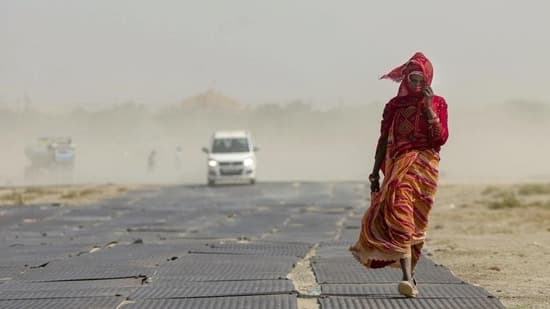
By mid-May 2026, summer had already turned unforgiving. Extreme heat has already been evidently felt across the parts of Uttar Pradesh, Haryana, Rajasthan, Madhya Pradesh, Maharashtra and Orissa where temperatures ranging from 47 C to 51 C were recorded weeks... By mid-May 2026, summer had already turned unforgiving. Extreme heat has already been evidently felt across the parts of Uttar Pradesh, Haryana, Rajasthan, Madhya Pradesh, Maharashtra and Orissa where temperatures ranging from 47°C to 51°C were recorded weeks ahead of seasonal timeline, as reported by India Meteorological Department (IMD). Additionally, IMD has issued warning of anomalously higher days of heatwave across northern, central, eastern and northwestern regions of India. Heatwaves are now seasonal reality which was earlier an event. However, the geography of this crisis now extends far beyond India’s traditionally heat-prone areas. From the agricultural belts of Punjab and Haryana to humid tea estates of Assam, rising temperatures are increasingly reshaping not only how but also whether millions of women can participate in work without hindrance. For India’s blue-collar women, the climate crisis is no longer a distant environmental concern rather it is a seasonal economic shock. Across the nation, several women sustain livelihoods via informal occupations like agricultural labour in Punjab’s wheat fields and Bihar’s paddy farms, tea plantation work in Assam, brick-kiln labour along the Gangetic plains, construction work in cities like Nagpur, street vending in Delhi and Ahmedabad, and garment stitching in Tamil Nadu. Also, they are earning their livelihood via home-based activities such as bidi rolling, tailoring, and food processing often in poorly ventilated spaces. All these occupations share one common defining feature that, they are highly exposed to heat and poor working conditions.As per the report of Lancet Countdown on Health and Climate Change 2025, India has lost approximately 247 billion potential labour hours in 2024 due to excessive high temperature which is equivalent to 419 hours per person, and which is also124% higher in comparison to the 1990s baseline. This associated economic loss of income is projected to be approximately $94 billion. Notably, the two sectors particularly agriculture and construction where women are disproportionately concentrated at the lowest end of the wage structure has suffered loss of 66% and 20% respectively of the total lost hours.Moreover, regional patterns of this seasonal crisis further complicate the scenario. In central and western India, excessive heat cause hindrance to outdoor labour, while in parts of Punjab and Bihar, rising temperatures during crucial agricultural cycles is reducing working hours in the fields, thereby affecting both productivity and wages. Also, in eastern parts of India, high humidity magnifies the heat stress, as this reduces the body’s ability to cool itself. Perhaps this, in urban centres, women working in unorganised sectors especially garments and small manufacturing units face heat trapped within enclosed poorly ventilated spaces.The rising temperature is also a deeply gendered challenge. According to the report of Food and Agriculture Organisation’s 2024, The Unjust Climate: Measuring the Impacts of Climate Change on the Rural Poor, Women and Youth,
ios_share
Share this article
Article Details
Hindustan Timesnational